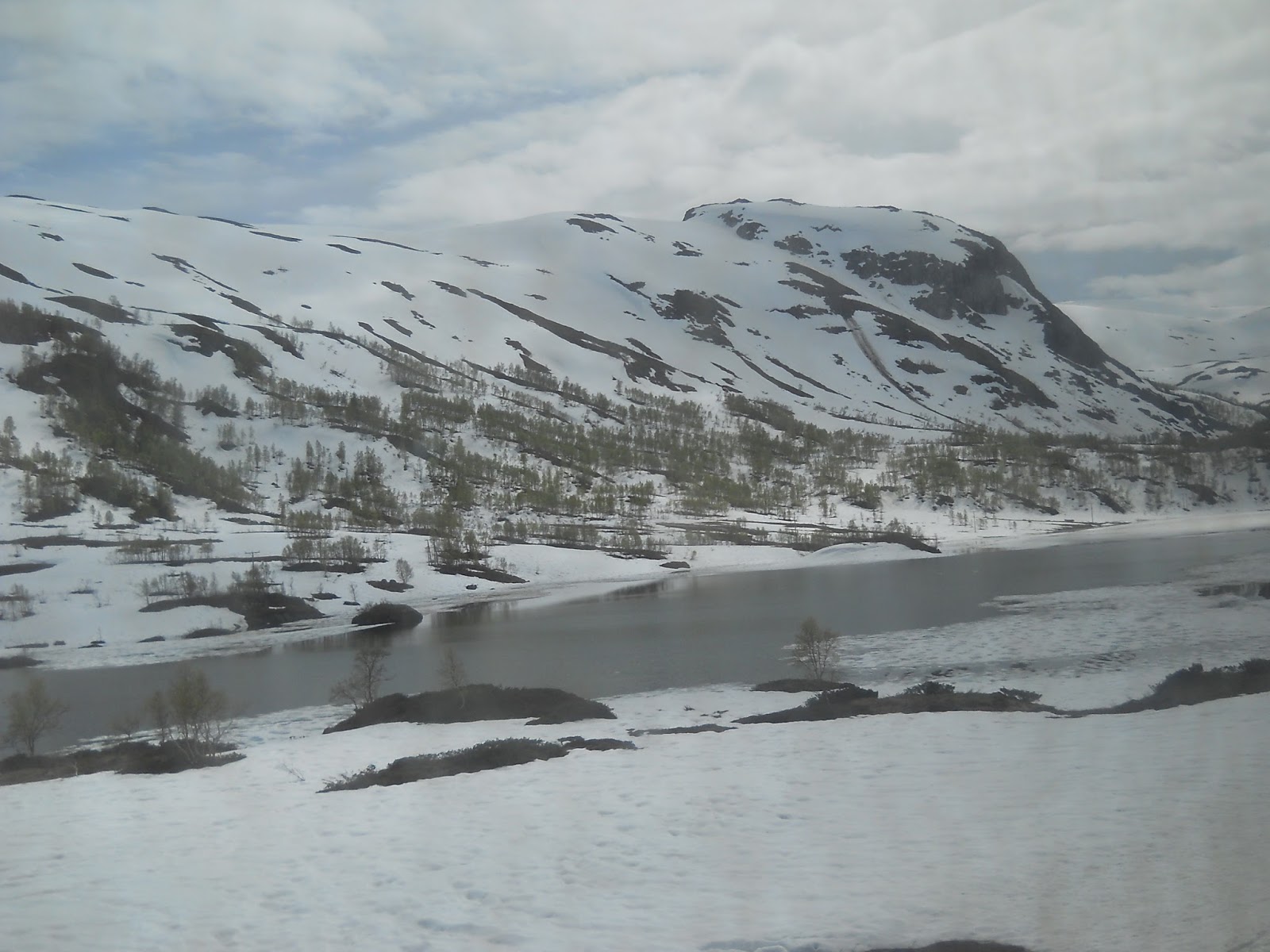
How could I write a series about Norway and not include something about Viking ships? In truth, I found Norway surprisingly quiet about its Old Norse past. Yes, the places we visited mentioned farming and shipping from what the rest of Europe calls the 'Viking era', but mentions seemed to be the sum total of it. Even Bergen, which houses the Maritime Museum, doesn't go, er... overboard.
So for this final post in the series I shall concentrate on two replica ships which have made their mark in different ways and in different areas. First up is Sea Stallion from Glendalough.
 |
| 'Sea Stallion from Glendalough' overwintering in Collins Barracks, Dublin, 2008 |
 |
| Note rowing benches and shape of the oars |
Back in 1962 several Viking era ships were excavated from a watery grave north of Roskilde in Denmark. One was found to be 96 feet in length - often referred to a 'dragon ship' - and believed to be a coastal-sailing prestige vessel incapable of enduring the rigours of the open sea. That misapprehension was sunk when dendrochronology proved it had been built around 1042 from Irish oak cut near Dublin.
From what was left of the original, blueprints were produced and a reproduction constructed using as close to known methods as possible. In 2004 it was launched, and in 2007 it was sailed using known Viking routes via Norway and Scotland to overwinter in Dublin, before returning to Denmark via the English Channel the following year. I recall watching a BBC programme on the first voyage during some of the roughest summer weather on record, expecting its back to break in the heaving seas, but seeing it flex along its entire length between wave troughs. It weighs 8 tons, has a draft of 3 feet and 60 oars. For its full statistics click HERE.
Sea Stallion from Glendalough still sails. Check out its interactive July 2015 route HERE.
The second replica ship is the Islendingur (Icelander), a copy of the Gokstad ship dating from 890 excavated from a burial mound in Norway in 1882. The original (more or less) now resides in the Viking Ship Museum in Oslo.
Islendingur was built in 1996, almost single-handedly by Gunnar Marel Eggertsson who had sailed the Norwegian Gokstad replica Gaia to Washington in 1991. It was intended as a teaching ship for Icelandic children, but with the millenium coming up it was decided to re-enact the voyage of Icelandic Sagas hero Leif Eriksson and sail from Iceland via the old Viking settlement in Greenland, to Vinland. This was achieved, with a crew of only 9 (plus a motor in case of problems) in 2000, with the ship landing at L'Anse au Meadows in Newfoundland, the single authenticated Viking settlement in North America.
The picture left gives some idea of its internal size. The diagonal beam is, in fact, its mast which fits into the 'foot' by the visitors. Note the loose-laid decking, unlike the integral seating for the Sea Stallion of Glendalough. 32 oarsmen would have crewed the original ship, sitting on their individual 'war chests'.
The ship is smaller (75 feet) and nearly half as wide again with a deeper draft, ideal for carrying provisions, including live animals. Its full statistics can be viewed by following the link below.
The ship now resides on permanent display at Vikingaheimar, the Viking World Museum specially built to house it at Reykjanesbaer on the Atlantic coast of Iceland, between Keflavik airport and the capital, Reykjavik.
To view the other posts in this series follow the links:
Norway 1: In the Wake of the Vikings
Norway 2: The Hopperstad Stave Church
Norway 3: Bergen & the Hanseatic League
The second replica ship is the Islendingur (Icelander), a copy of the Gokstad ship dating from 890 excavated from a burial mound in Norway in 1882. The original (more or less) now resides in the Viking Ship Museum in Oslo.
 |
The picture left gives some idea of its internal size. The diagonal beam is, in fact, its mast which fits into the 'foot' by the visitors. Note the loose-laid decking, unlike the integral seating for the Sea Stallion of Glendalough. 32 oarsmen would have crewed the original ship, sitting on their individual 'war chests'.
The ship is smaller (75 feet) and nearly half as wide again with a deeper draft, ideal for carrying provisions, including live animals. Its full statistics can be viewed by following the link below.
The ship now resides on permanent display at Vikingaheimar, the Viking World Museum specially built to house it at Reykjanesbaer on the Atlantic coast of Iceland, between Keflavik airport and the capital, Reykjavik.
To view the other posts in this series follow the links:
Norway 1: In the Wake of the Vikings
Norway 2: The Hopperstad Stave Church
Norway 3: Bergen & the Hanseatic League